> ## Documentation Index
> Fetch the complete documentation index at: https://docs.reducto.ai/llms.txt
> Use this file to discover all available pages before exploring further.
# Multi-lingual Document Processing
> Process documents in 60+ languages with automatic language detection and OCR configuration
Process documents in 60+ languages with automatic language detection. No configuration required.
***
## Sample Document
Download the sample: [un-document-spanish.pdf](/samples/un-document-spanish.pdf)
***
## Supported Languages
Reducto automatically detects and processes these languages:
| Region | Languages |
| ------------------ | --------------------------------------------------------------------------------------------------------------------------------------------------------------------------------------------------------------------------------------------------------------------------------------------- |
| **European** | English, German, French, Spanish, Portuguese, Italian, Dutch, Polish, Romanian, Czech, Greek, Hungarian, Swedish, Danish, Finnish, Norwegian, Bulgarian, Croatian, Slovak, Slovenian, Lithuanian, Latvian, Estonian, Albanian, Icelandic, Catalan, Serbian, Macedonian, Belarusian, Ukrainian |
| **Asian** | Chinese, Japanese, Korean, Hindi, Bengali, Tamil, Telugu, Marathi, Gujarati, Kannada, Malayalam, Punjabi, Thai, Vietnamese, Indonesian, Malay, Filipino/Tagalog, Khmer, Lao, Nepali |
| **Middle Eastern** | Arabic, Hebrew, Persian, Turkish |
| **Other** | Russian, Armenian, Yiddish, Afrikaans |
The standard OCR handles **mixed-language documents** automatically. A single document can contain text in multiple languages without any special configuration.
***
## Create API Key
Go to [studio.reducto.ai](https://studio.reducto.ai) and sign in. From the home page, click **API Keys** in the left sidebar.
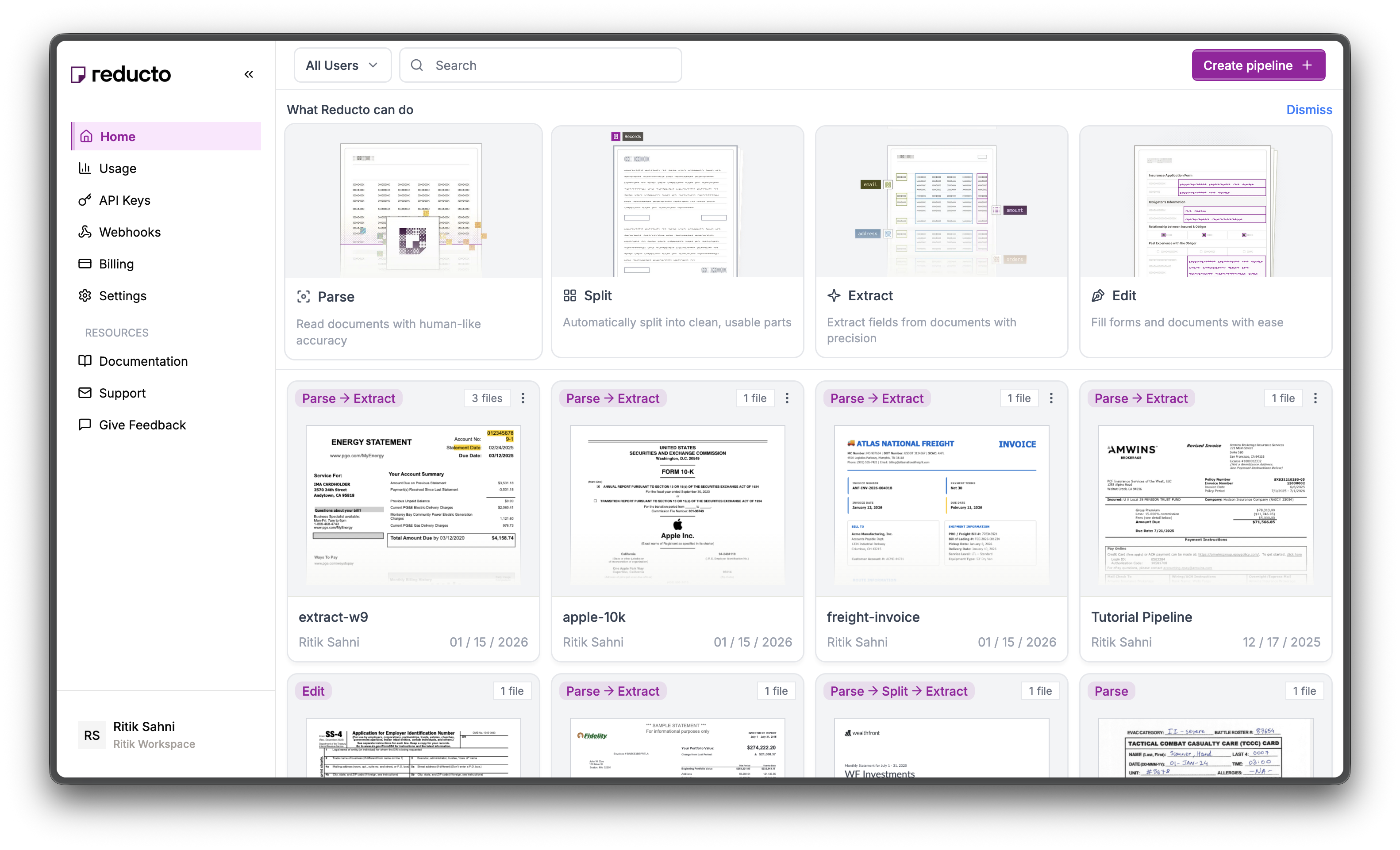 The API Keys page shows your existing keys. Click **+ Create new API key** in the top right corner.
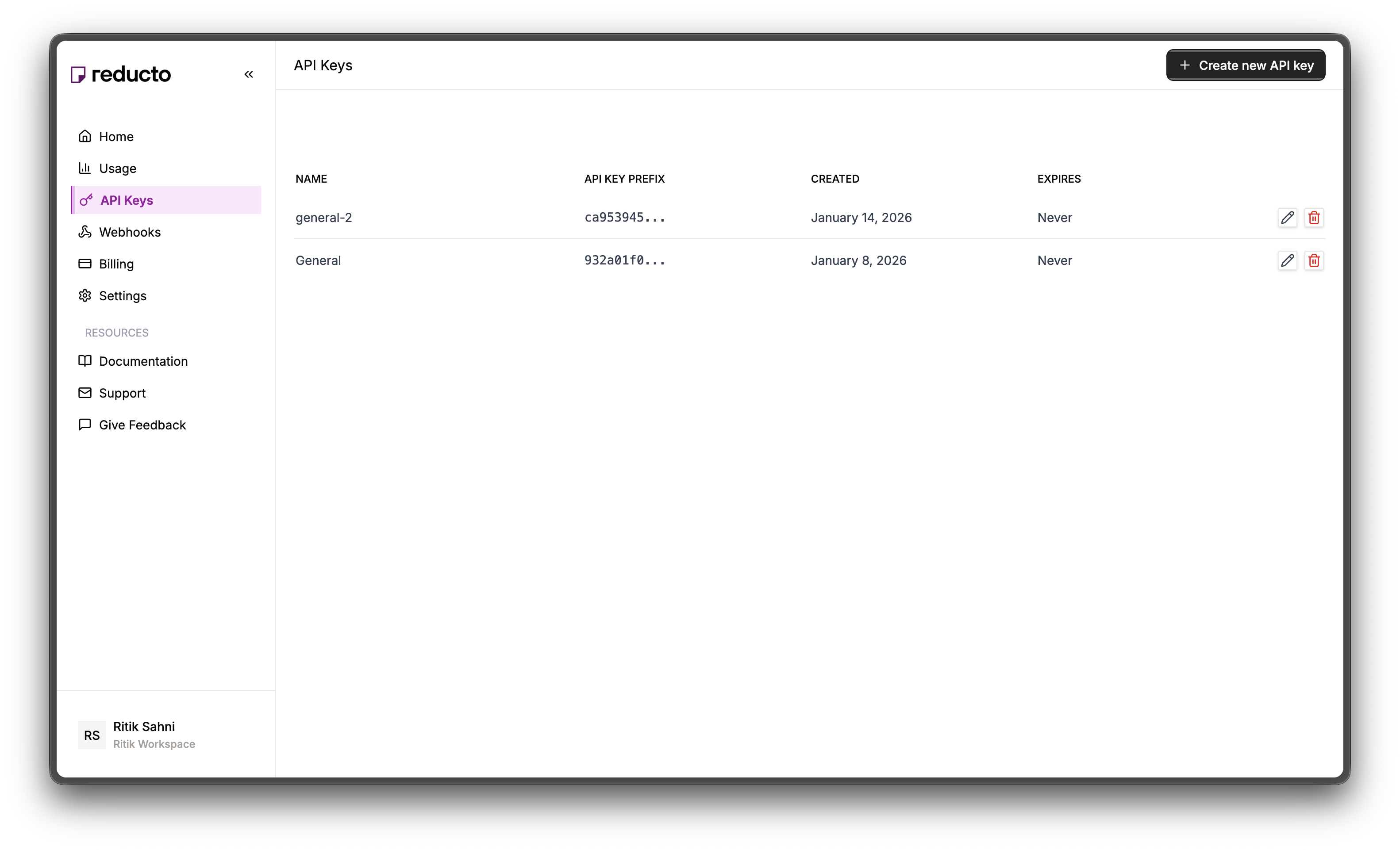 In the modal, enter a name for your key and set an expiration policy (or select "Never" for no expiration). Click **Create**.
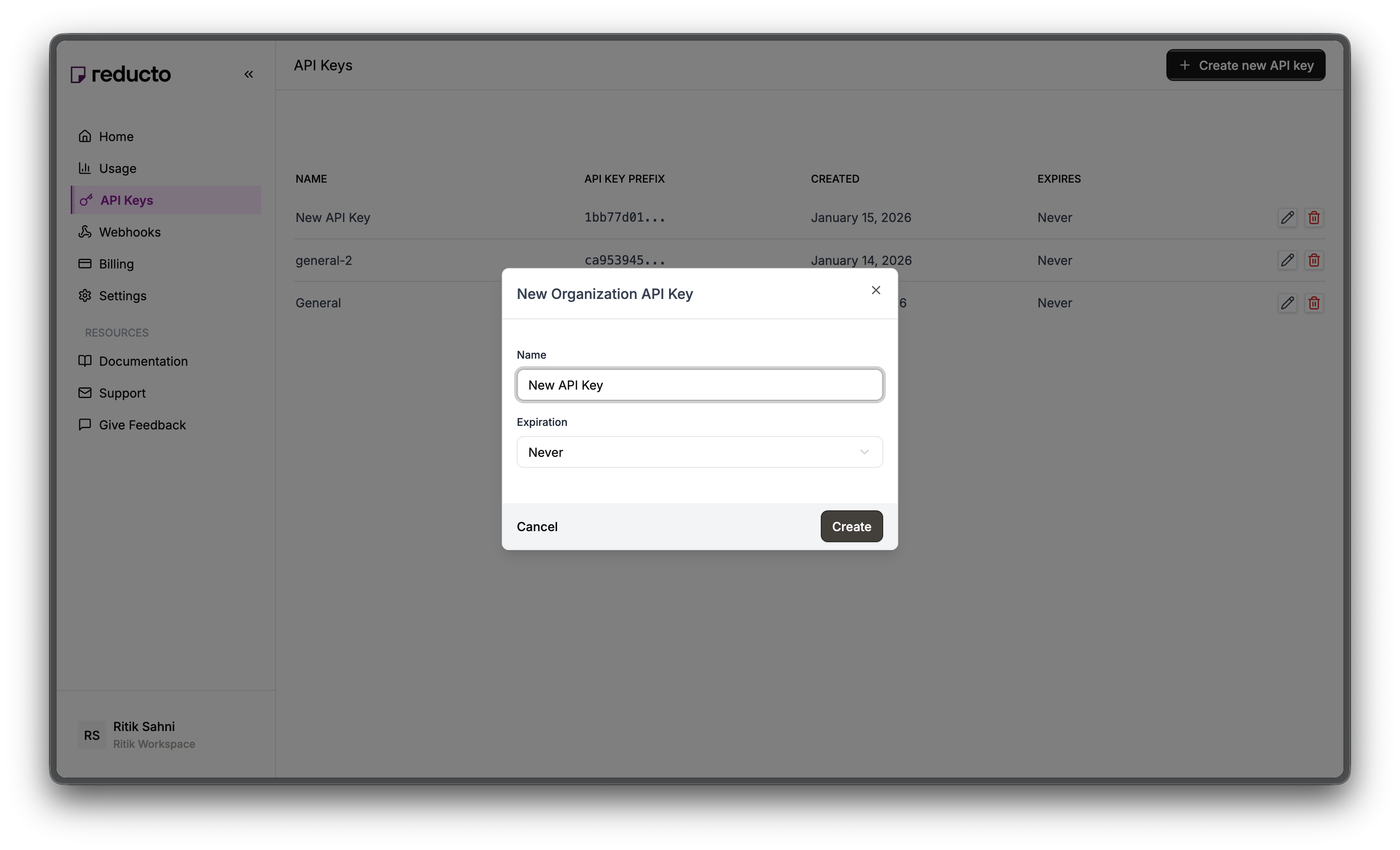 Copy your new API key and store it securely. You won't be able to see it again after closing this dialog.
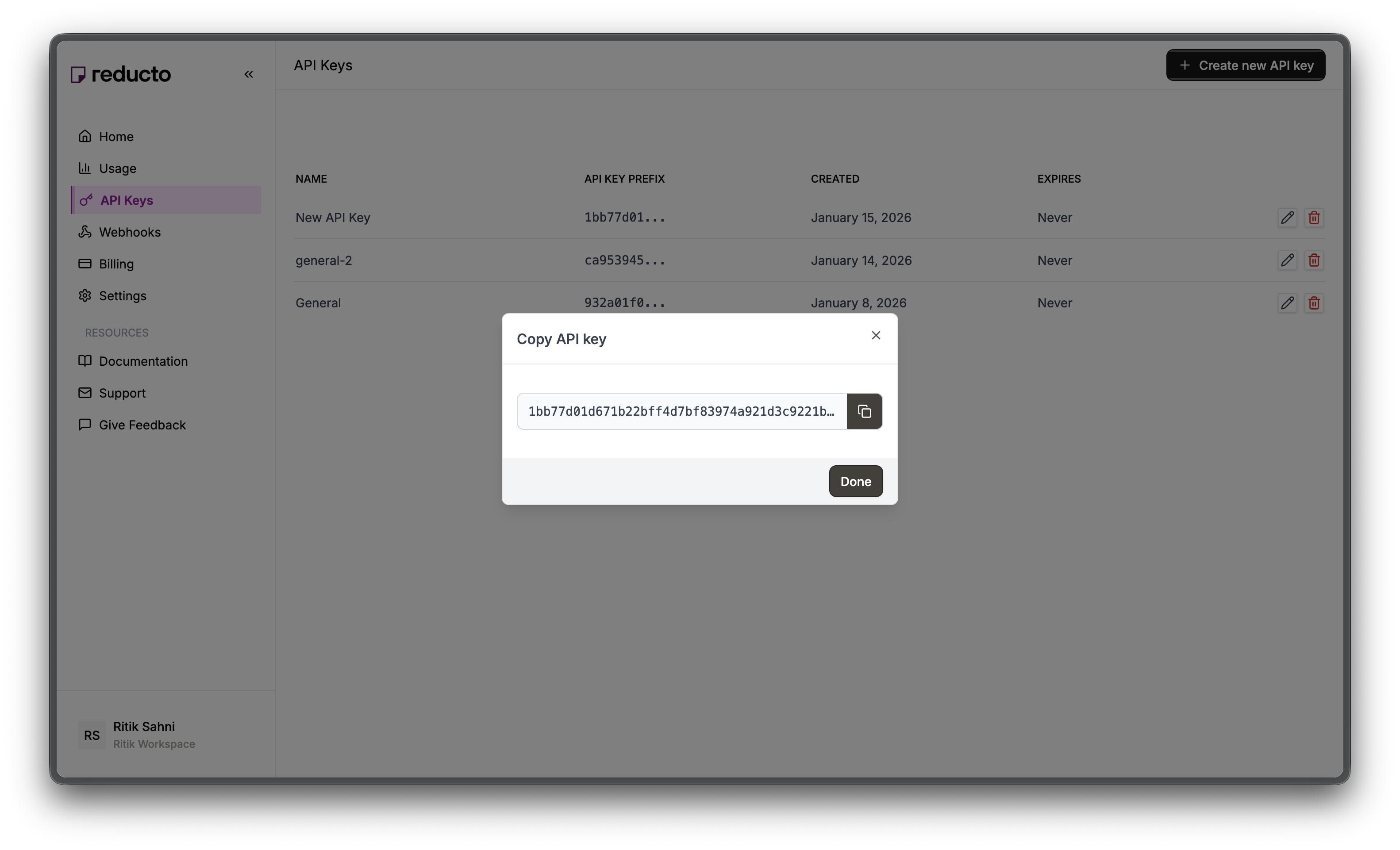 Set the key as an environment variable:
```bash theme={null}
export REDUCTO_API_KEY="your-api-key-here"
```
***
## Studio Walkthrough
Upload your multilingual document to [studio.reducto.ai](https://studio.reducto.ai). In the **Parse** view, open the **Configurations** tab to see OCR settings.
Set the key as an environment variable:
```bash theme={null}
export REDUCTO_API_KEY="your-api-key-here"
```
***
## Studio Walkthrough
Upload your multilingual document to [studio.reducto.ai](https://studio.reducto.ai). In the **Parse** view, open the **Configurations** tab to see OCR settings.
 Key settings:
* **Extraction Mode**: Use `ocr` for scanned documents where text is embedded as images. Use `hybrid` (default) for mixed documents where some pages are native text and others are scans.
* **OCR System**: Keep `standard` (default) for 60+ language support. The `legacy` system only supports Germanic languages.
Click **Run** and switch to the **Results** tab. Reducto extracts text in the original language with proper character encoding.
Key settings:
* **Extraction Mode**: Use `ocr` for scanned documents where text is embedded as images. Use `hybrid` (default) for mixed documents where some pages are native text and others are scans.
* **OCR System**: Keep `standard` (default) for 60+ language support. The `legacy` system only supports Germanic languages.
Click **Run** and switch to the **Results** tab. Reducto extracts text in the original language with proper character encoding.
 Notice how the Spanish text is extracted accurately, including accented characters (á, é, í, ó, ú, ñ) and proper formatting.
***
## Processing Non-English Documents
### Basic Usage
No special configuration needed - just parse as usual:
```python Python theme={null}
from pathlib import Path
from reducto import Reducto
client = Reducto()
# Upload Spanish document
upload = client.upload(file=Path("documento_español.pdf"))
# Parse - language is detected automatically
result = client.parse.run(input=upload.file_id)
# Access extracted text
for chunk in result.result.chunks:
print(chunk.content)
```
```javascript JavaScript theme={null}
import Reducto from "reductoai";
import fs from "fs";
const client = new Reducto();
// Upload Spanish document
const upload = await client.upload({
file: fs.createReadStream("documento_español.pdf"),
});
// Parse - language is detected automatically
const result = await client.parse.run({ input: upload.file_id });
// Access extracted text
for (const chunk of result.result.chunks) {
console.log(chunk.content);
}
```
### Output Example
From a Spanish UN Security Council document:
```
Naciones Unidas
S/2025/856
Consejo de Seguridad
Distr. general
30 de diciembre de 2025
Español
Original: inglés
Carta de fecha 29 de diciembre de 2025 dirigida a la
Presidencia del Consejo de Seguridad por el Secretario General
Tengo el honor de referirme a la resolución 2719 (2023) del Consejo de
Seguridad, por la que el Consejo estableció el marco para financiar las
operaciones de paz...
```
***
## OCR Configuration Options
### Extraction Modes
Choose the right mode for your document type:
```python Python theme={null}
# For scanned documents (images, old PDFs)
result = client.parse.run(
input=upload.file_id,
settings={
"extraction_mode": "ocr" # Force OCR, ignore embedded text
}
)
# For native PDFs with embedded text
result = client.parse.run(
input=upload.file_id,
settings={
"extraction_mode": "metadata" # Use embedded text only
}
)
# For mixed documents (default)
result = client.parse.run(
input=upload.file_id,
settings={
"extraction_mode": "hybrid" # Use metadata first, OCR as fallback
}
)
```
```javascript JavaScript theme={null}
// For scanned documents (images, old PDFs)
const resultOcr = await client.parse.run({
input: upload.file_id,
settings: {
extraction_mode: "ocr" // Force OCR, ignore embedded text
}
});
// For native PDFs with embedded text
const resultMetadata = await client.parse.run({
input: upload.file_id,
settings: {
extraction_mode: "metadata" // Use embedded text only
}
});
// For mixed documents (default)
const resultHybrid = await client.parse.run({
input: upload.file_id,
settings: {
extraction_mode: "hybrid" // Use metadata first, OCR as fallback
}
});
```
| Mode | Best For | Speed | Accuracy |
| ---------- | ------------------- | ------- | ---------------------- |
| `hybrid` | Mixed document sets | Fast | High |
| `ocr` | Scanned documents | Slower | High |
| `metadata` | Native PDFs | Fastest | Depends on PDF quality |
### OCR System Selection
Always use `standard` for multilingual support:
```python Python theme={null}
result = client.parse.run(
input=upload.file_id,
settings={
"ocr_system": "standard" # 60+ languages (default)
}
)
```
```javascript JavaScript theme={null}
const result = await client.parse.run({
input: upload.file_id,
settings: {
ocr_system: "standard" // 60+ languages (default)
}
});
```
The `legacy` OCR system only supports Germanic languages (English, German, Dutch, etc.). Always use `standard` for non-Germanic languages.
***
## Mixed-Language Documents
Documents containing multiple languages are handled automatically:
```python Python theme={null}
# A document with English headers and Spanish content
result = client.parse.run(input=upload.file_id)
# Both languages are extracted correctly
# No configuration needed
```
```javascript JavaScript theme={null}
// A document with English headers and Spanish content
const result = await client.parse.run({ input: upload.file_id });
// Both languages are extracted correctly
// No configuration needed
```
### Example: Bilingual Contract
```
AGREEMENT / ACUERDO
This agreement ("Agreement") is entered into between...
Este acuerdo ("Acuerdo") se celebra entre...
TERMS AND CONDITIONS / TÉRMINOS Y CONDICIONES
1. Definitions / Definiciones
The following terms shall have the meanings set forth below...
Los siguientes términos tendrán los significados establecidos a continuación...
```
Reducto extracts both English and Spanish text accurately.
***
## Agentic Mode for Difficult Text
Standard OCR works well for clean, printed documents. For challenging documents like handwriting, faded text, or unusual fonts, agentic mode uses a vision language model to verify and correct OCR output.
```python Python theme={null}
result = client.parse.run(
input=upload.file_id,
enhance={
"agentic": [{"scope": "text"}]
}
)
```
```javascript JavaScript theme={null}
const result = await client.parse.run({
input: upload.file_id,
enhance: {
agentic: [{ scope: "text" }]
}
});
```
Use agentic mode when:
* Text is handwritten or uses decorative fonts
* Document is faded, stained, or low quality
* OCR produces garbled output on first pass
Agentic mode costs approximately 2x credits. Use it selectively for documents where standard OCR struggles.
***
## Extracting Structured Data
Extract structured data from non-English documents using schemas with descriptive field hints:
```python Python theme={null}
# Schema for Spanish invoice
spanish_invoice_schema = {
"type": "object",
"properties": {
"numero_factura": {
"type": "string",
"description": "Número de factura / Invoice number"
},
"fecha": {
"type": "string",
"description": "Fecha de la factura / Invoice date"
},
"proveedor": {
"type": "object",
"description": "Información del proveedor / Vendor information",
"properties": {
"nombre": {"type": "string"},
"direccion": {"type": "string"},
"nif": {"type": "string", "description": "NIF/CIF fiscal ID"}
}
},
"cliente": {
"type": "object",
"description": "Información del cliente / Customer information",
"properties": {
"nombre": {"type": "string"},
"direccion": {"type": "string"}
}
},
"lineas": {
"type": "array",
"description": "Líneas de factura / Line items",
"items": {
"type": "object",
"properties": {
"descripcion": {"type": "string"},
"cantidad": {"type": "number"},
"precio_unitario": {"type": "number"},
"importe": {"type": "number"}
}
}
},
"subtotal": {"type": "number"},
"iva": {"type": "number", "description": "IVA / VAT amount"},
"total": {"type": "number"}
}
}
result = client.extract.run(
input=upload.file_id,
instructions={"schema": spanish_invoice_schema}
)
print(f"Factura: {result.result['numero_factura']}")
print(f"Total: €{result.result['total']}")
```
```javascript JavaScript theme={null}
// Schema for Spanish invoice
const spanishInvoiceSchema = {
type: "object",
properties: {
numero_factura: {
type: "string",
description: "Número de factura / Invoice number"
},
fecha: {
type: "string",
description: "Fecha de la factura / Invoice date"
},
proveedor: {
type: "object",
description: "Información del proveedor / Vendor information",
properties: {
nombre: { type: "string" },
direccion: { type: "string" },
nif: { type: "string", description: "NIF/CIF fiscal ID" }
}
},
cliente: {
type: "object",
description: "Información del cliente / Customer information",
properties: {
nombre: { type: "string" },
direccion: { type: "string" }
}
},
lineas: {
type: "array",
description: "Líneas de factura / Line items",
items: {
type: "object",
properties: {
descripcion: { type: "string" },
cantidad: { type: "number" },
precio_unitario: { type: "number" },
importe: { type: "number" }
}
}
},
subtotal: { type: "number" },
iva: { type: "number", description: "IVA / VAT amount" },
total: { type: "number" }
}
};
const result = await client.extract.run({
input: upload.file_id,
instructions: { schema: spanishInvoiceSchema }
});
const data = result.result[0]; // Note: result.result is an array
console.log(`Factura: ${data.numero_factura}`);
console.log(`Total: €${data.total}`);
```
Include field descriptions in both the source language and English to improve extraction accuracy.
***
## Tips
For best results with non-English documents:
1. **Use high-quality scans** (300 DPI minimum) for better OCR accuracy
2. **Enable agentic mode** for handwritten or degraded text
3. **Provide bilingual field descriptions** in extraction schemas to improve accuracy
4. **Use `extraction_mode: "ocr"`** for scanned documents instead of relying on embedded text
***
## Next Steps
Full OCR configuration reference
AI-enhanced text correction
Process many documents at scale
Structured data extraction
Notice how the Spanish text is extracted accurately, including accented characters (á, é, í, ó, ú, ñ) and proper formatting.
***
## Processing Non-English Documents
### Basic Usage
No special configuration needed - just parse as usual:
```python Python theme={null}
from pathlib import Path
from reducto import Reducto
client = Reducto()
# Upload Spanish document
upload = client.upload(file=Path("documento_español.pdf"))
# Parse - language is detected automatically
result = client.parse.run(input=upload.file_id)
# Access extracted text
for chunk in result.result.chunks:
print(chunk.content)
```
```javascript JavaScript theme={null}
import Reducto from "reductoai";
import fs from "fs";
const client = new Reducto();
// Upload Spanish document
const upload = await client.upload({
file: fs.createReadStream("documento_español.pdf"),
});
// Parse - language is detected automatically
const result = await client.parse.run({ input: upload.file_id });
// Access extracted text
for (const chunk of result.result.chunks) {
console.log(chunk.content);
}
```
### Output Example
From a Spanish UN Security Council document:
```
Naciones Unidas
S/2025/856
Consejo de Seguridad
Distr. general
30 de diciembre de 2025
Español
Original: inglés
Carta de fecha 29 de diciembre de 2025 dirigida a la
Presidencia del Consejo de Seguridad por el Secretario General
Tengo el honor de referirme a la resolución 2719 (2023) del Consejo de
Seguridad, por la que el Consejo estableció el marco para financiar las
operaciones de paz...
```
***
## OCR Configuration Options
### Extraction Modes
Choose the right mode for your document type:
```python Python theme={null}
# For scanned documents (images, old PDFs)
result = client.parse.run(
input=upload.file_id,
settings={
"extraction_mode": "ocr" # Force OCR, ignore embedded text
}
)
# For native PDFs with embedded text
result = client.parse.run(
input=upload.file_id,
settings={
"extraction_mode": "metadata" # Use embedded text only
}
)
# For mixed documents (default)
result = client.parse.run(
input=upload.file_id,
settings={
"extraction_mode": "hybrid" # Use metadata first, OCR as fallback
}
)
```
```javascript JavaScript theme={null}
// For scanned documents (images, old PDFs)
const resultOcr = await client.parse.run({
input: upload.file_id,
settings: {
extraction_mode: "ocr" // Force OCR, ignore embedded text
}
});
// For native PDFs with embedded text
const resultMetadata = await client.parse.run({
input: upload.file_id,
settings: {
extraction_mode: "metadata" // Use embedded text only
}
});
// For mixed documents (default)
const resultHybrid = await client.parse.run({
input: upload.file_id,
settings: {
extraction_mode: "hybrid" // Use metadata first, OCR as fallback
}
});
```
| Mode | Best For | Speed | Accuracy |
| ---------- | ------------------- | ------- | ---------------------- |
| `hybrid` | Mixed document sets | Fast | High |
| `ocr` | Scanned documents | Slower | High |
| `metadata` | Native PDFs | Fastest | Depends on PDF quality |
### OCR System Selection
Always use `standard` for multilingual support:
```python Python theme={null}
result = client.parse.run(
input=upload.file_id,
settings={
"ocr_system": "standard" # 60+ languages (default)
}
)
```
```javascript JavaScript theme={null}
const result = await client.parse.run({
input: upload.file_id,
settings: {
ocr_system: "standard" // 60+ languages (default)
}
});
```
The `legacy` OCR system only supports Germanic languages (English, German, Dutch, etc.). Always use `standard` for non-Germanic languages.
***
## Mixed-Language Documents
Documents containing multiple languages are handled automatically:
```python Python theme={null}
# A document with English headers and Spanish content
result = client.parse.run(input=upload.file_id)
# Both languages are extracted correctly
# No configuration needed
```
```javascript JavaScript theme={null}
// A document with English headers and Spanish content
const result = await client.parse.run({ input: upload.file_id });
// Both languages are extracted correctly
// No configuration needed
```
### Example: Bilingual Contract
```
AGREEMENT / ACUERDO
This agreement ("Agreement") is entered into between...
Este acuerdo ("Acuerdo") se celebra entre...
TERMS AND CONDITIONS / TÉRMINOS Y CONDICIONES
1. Definitions / Definiciones
The following terms shall have the meanings set forth below...
Los siguientes términos tendrán los significados establecidos a continuación...
```
Reducto extracts both English and Spanish text accurately.
***
## Agentic Mode for Difficult Text
Standard OCR works well for clean, printed documents. For challenging documents like handwriting, faded text, or unusual fonts, agentic mode uses a vision language model to verify and correct OCR output.
```python Python theme={null}
result = client.parse.run(
input=upload.file_id,
enhance={
"agentic": [{"scope": "text"}]
}
)
```
```javascript JavaScript theme={null}
const result = await client.parse.run({
input: upload.file_id,
enhance: {
agentic: [{ scope: "text" }]
}
});
```
Use agentic mode when:
* Text is handwritten or uses decorative fonts
* Document is faded, stained, or low quality
* OCR produces garbled output on first pass
Agentic mode costs approximately 2x credits. Use it selectively for documents where standard OCR struggles.
***
## Extracting Structured Data
Extract structured data from non-English documents using schemas with descriptive field hints:
```python Python theme={null}
# Schema for Spanish invoice
spanish_invoice_schema = {
"type": "object",
"properties": {
"numero_factura": {
"type": "string",
"description": "Número de factura / Invoice number"
},
"fecha": {
"type": "string",
"description": "Fecha de la factura / Invoice date"
},
"proveedor": {
"type": "object",
"description": "Información del proveedor / Vendor information",
"properties": {
"nombre": {"type": "string"},
"direccion": {"type": "string"},
"nif": {"type": "string", "description": "NIF/CIF fiscal ID"}
}
},
"cliente": {
"type": "object",
"description": "Información del cliente / Customer information",
"properties": {
"nombre": {"type": "string"},
"direccion": {"type": "string"}
}
},
"lineas": {
"type": "array",
"description": "Líneas de factura / Line items",
"items": {
"type": "object",
"properties": {
"descripcion": {"type": "string"},
"cantidad": {"type": "number"},
"precio_unitario": {"type": "number"},
"importe": {"type": "number"}
}
}
},
"subtotal": {"type": "number"},
"iva": {"type": "number", "description": "IVA / VAT amount"},
"total": {"type": "number"}
}
}
result = client.extract.run(
input=upload.file_id,
instructions={"schema": spanish_invoice_schema}
)
print(f"Factura: {result.result['numero_factura']}")
print(f"Total: €{result.result['total']}")
```
```javascript JavaScript theme={null}
// Schema for Spanish invoice
const spanishInvoiceSchema = {
type: "object",
properties: {
numero_factura: {
type: "string",
description: "Número de factura / Invoice number"
},
fecha: {
type: "string",
description: "Fecha de la factura / Invoice date"
},
proveedor: {
type: "object",
description: "Información del proveedor / Vendor information",
properties: {
nombre: { type: "string" },
direccion: { type: "string" },
nif: { type: "string", description: "NIF/CIF fiscal ID" }
}
},
cliente: {
type: "object",
description: "Información del cliente / Customer information",
properties: {
nombre: { type: "string" },
direccion: { type: "string" }
}
},
lineas: {
type: "array",
description: "Líneas de factura / Line items",
items: {
type: "object",
properties: {
descripcion: { type: "string" },
cantidad: { type: "number" },
precio_unitario: { type: "number" },
importe: { type: "number" }
}
}
},
subtotal: { type: "number" },
iva: { type: "number", description: "IVA / VAT amount" },
total: { type: "number" }
}
};
const result = await client.extract.run({
input: upload.file_id,
instructions: { schema: spanishInvoiceSchema }
});
const data = result.result[0]; // Note: result.result is an array
console.log(`Factura: ${data.numero_factura}`);
console.log(`Total: €${data.total}`);
```
Include field descriptions in both the source language and English to improve extraction accuracy.
***
## Tips
For best results with non-English documents:
1. **Use high-quality scans** (300 DPI minimum) for better OCR accuracy
2. **Enable agentic mode** for handwritten or degraded text
3. **Provide bilingual field descriptions** in extraction schemas to improve accuracy
4. **Use `extraction_mode: "ocr"`** for scanned documents instead of relying on embedded text
***
## Next Steps
Full OCR configuration reference
AI-enhanced text correction
Process many documents at scale
Structured data extraction